
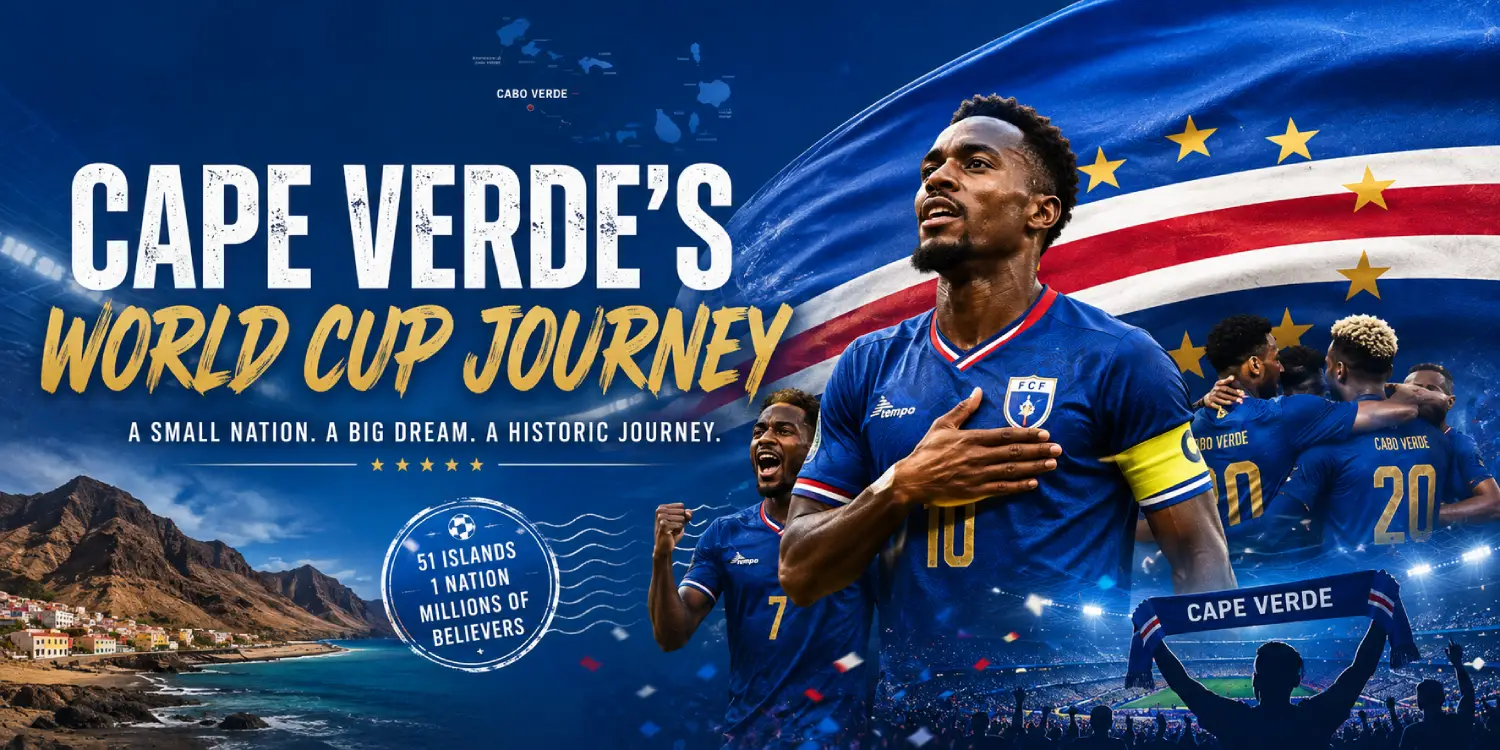
Quick answer: Cape Verde — the “Blue Sharks” — reached the 2026 FIFA World Cup for the first time in their history, then went unbeaten through Group H to become the smallest nation by population ever to reach a World Cup knockout stage. With a population of just over 525,000, they finished second behind Spain and now face reigning world champions Argentina in the Round of 32 on 3 July in Miami.
There are underdog stories, and then there is Cape Verde. In the summer of 2026, a chain of ten volcanic islands in the middle of the Atlantic — home to fewer people than a mid-sized city — walked onto football’s biggest stage for the very first time and refused to leave. This is the full story of the Cape Verde World Cup journey: how they qualified, how they played, how they keep improving, and how they fought.
Key facts at a glance
| Detail | Information |
|---|---|
| Nation | Cape Verde (Cabo Verde), West Africa |
| Nickname | The Blue Sharks (Tubarões Azuis) |
| Population | Around 525,000 |
| FIFA ranking entering tournament | 67th |
| World Cup debut | 2026 (first-ever appearance) |
| Manager | Bubista (Pedro Leitão Brito), in charge since 2020 |
| Group | Group H (Spain, Uruguay, Saudi Arabia) |
| Group result | 2nd place, unbeaten (3 draws) |
| Historic milestone | Smallest nation by population ever to reach the knockouts |
| Next match | vs Argentina, Round of 32, 3 July 2026, Miami |
Table of contents
- Who are Cape Verde, the “Blue Sharks”?
- The road to qualification
- Cape Verde at the 2026 World Cup: Group H
- The heroes behind the run
- Records Cape Verde broke
- How Cape Verde keep improving
- Cape Verde vs Argentina: Round of 32 preview
- What this journey means
- Frequently asked questions
Who are Cape Verde, the “Blue Sharks”?
Cape Verde, known in Portuguese as Cabo Verde, is an archipelago of ten islands sitting roughly 600 kilometres off the west coast of Africa. A former Portuguese colony, it has a tiny resident population — around 525,000 — but an enormous diaspora spread across Europe and the Americas. That diaspora is the secret engine of this football team.
Most of the squad were born or raised in Europe — in Portugal, the Netherlands, France and beyond — within communities that carry deep Cape Verdean roots, before choosing to represent the islands of their heritage. The result is a side that blends the polish of European club football with a fierce, almost familial sense of collective identity. They are nicknamed the Blue Sharks (Tubarões Azuis), and in 2026 they became the third-smallest nation by population ever to appear at a World Cup.
At the heart of the project is the manager, Bubista (full name Pedro Leitão Brito), a former Cape Verde international who has led the national team since 2020. His football philosophy is simple to describe and brutal to play against: a compact, disciplined defensive block, relentless organisation, and a willingness to strike on the counter-attack. It is a blueprint built for a small nation taking on giants — and in 2026 it worked to perfection.
The road to qualification: how Cape Verde reached the 2026 World Cup
Seven failed attempts, then a breakthrough
Cape Verde had tried to reach a World Cup seven times before and fallen short every time. The 2026 cycle was different. Drawn into CAF qualifying Group D alongside continental heavyweight Cameroon — an eight-time World Cup participant — plus Angola, Libya, Eswatini and Mauritius, the Blue Sharks produced the qualifying campaign of their lives.
CAF Group D: outlasting Cameroon
Across ten matches in a home-and-away format, Cape Verde collected 23 points from a possible 30: seven wins, two draws and a single defeat. They scored 16 goals and conceded only 8, keeping seven clean sheets — the defensive solidity that would later define their World Cup already on full display. Their only loss came away in Cameroon.
The turning point was a run of five straight victories, crowned by a famous 1-0 home win over Cameroon in September 2025, with striker Dailon Livramento scoring the decisive goal. A wild 3-3 comeback away in Libya, after trailing 3-1, kept their destiny firmly in their own hands.
The night it became real
On 13 October 2025, at the Estádio Nacional in Praia, Cape Verde finished the job with a 3-0 win over Eswatini. Livramento opened the scoring, Willy Semedo added the second, and the veteran Stopira sealed it late. The islands erupted. A generation of work, and seven tournaments of heartbreak, ended in a single golden night. Cape Verde topped the group four points clear of Cameroon and booked a direct ticket to North America. Manager Bubista was later named CAF African Head Coach of the Year for the achievement.
Cape Verde at the 2026 World Cup: inside Group H
The World Cup draw was unkind. Group H paired the debutants with European champions Spain, two-time world champions Uruguay, and a battle-hardened Saudi Arabia. Ranked 67th in the world, Cape Verde were nobody’s pick to advance. Bubista knew it, and leaned into it.
Group H final standings
| Pos | Team | Pld | W | D | L | GF | GA | GD | Pts |
|---|---|---|---|---|---|---|---|---|---|
| 1 | Spain | 3 | 2 | 1 | 0 | 5 | 0 | +5 | 7 |
| 2 | Cape Verde | 3 | 0 | 3 | 0 | 2 | 2 | 0 | 3 |
| 3 | Uruguay | 3 | 0 | 2 | 1 | 3 | 4 | −1 | 2 |
| 4 | Saudi Arabia | 3 | 0 | 2 | 1 | 1 | 5 | −4 | 2 |
Cape Verde finished second and advanced. Both Uruguay and Saudi Arabia were eliminated.
Match 1 — Spain 0-0 Cape Verde (Atlanta)
In their first-ever World Cup match, the Blue Sharks held the European champions to a goalless draw and earned the first point in their World Cup history. The hero was a 40-year-old goalkeeper named Vozinha, who produced a seven-save clean sheet that single-handedly kept Cape Verde standing. Overnight, he became a global sensation.
Match 2 — Uruguay 2-2 Cape Verde (Miami)
Six days later came the day Cape Verde finally scored. In the 21st minute, Kevin Pina struck the first World Cup goal in the nation’s history. Hélio Varela added a second in the 61st. Twice getting on the scoresheet against a two-time world champion turned a brave start into a genuine push for the knockout rounds.
Match 3 — Cape Verde 0-0 Saudi Arabia (Houston)
The decider was tense and tight. Vozinha kept yet another clean sheet, Spain’s win over Uruguay elsewhere fell in their favour, and a third consecutive draw was enough. Cape Verde secured second place in Group H on three points — unbeaten across all three matches and through to the Round of 32.
The heroes behind the run
What carried Cape Verde was not star power but stubbornness. Bubista’s defensive blueprint nullified elite European and South American attacks for 270 minutes, and a team ranked 67th in the world simply refused to be beaten.
Vozinha — the 40-year-old wall
The figurehead of the run was goalkeeper Vozinha (full name Josimar “Vozinha” José Évora Dias). By keeping clean sheets against both Spain and Saudi Arabia, the 40-year-old joined legends Dino Zoff and Peter Shilton as the only goalkeepers aged 40 or older to record multiple clean sheets in a single World Cup. His online following swelled into the millions during the group stage, and the cameras repeatedly found his mother celebrating in the stands.
Ryan Mendes — the captain and record-holder
Captain Ryan Mendes is the face of Cape Verdean football, holding the national records for both most caps and most goals. His leadership across the qualifying campaign and into the tournament earned him a place at his first — and likely only — World Cup.
The goalscorers and the collective
Beyond Vozinha and Mendes stood a team of character. Kevin Pina and Hélio Varela delivered the historic goals against Uruguay. Dailon Livramento was the cutting edge throughout qualification. Roberto “Pico” Lopes and the evergreen Stopira anchored the defence, supported by diaspora-developed talents such as Logan Costa, Garry Rodrigues and Jovane Cabral. The strength was the whole, not any single part.
Cape Verde’s key players
| Player | Role | Why they matter |
|---|---|---|
| Vozinha | Goalkeeper | Two clean sheets; the heartbeat of the run |
| Ryan Mendes | Captain / forward | National record-holder for caps and goals |
| Kevin Pina | Midfielder | Scored Cape Verde’s first-ever World Cup goal |
| Hélio Varela | Winger | Scored the second goal vs Uruguay |
| Dailon Livramento | Striker | Qualifying hero, including the Cameroon winner |
| Roberto “Pico” Lopes | Defender | Leader of the back line |
Records Cape Verde broke
Cape Verde’s run rewrote several pages of the record books:
- Smallest nation by population ever to reach a World Cup knockout stage.
- First debutant nation to go unbeaten in its opening three group-stage matches since Senegal in 2002.
- Third African nation to avoid defeat across its first three World Cup appearances, matching the historic starts of Senegal and Cameroon.
- Vozinha became one of only a handful of goalkeepers aged 40 or older — alongside Dino Zoff and Peter Shilton — to keep multiple clean sheets in a single World Cup.
- A debutant advancing to face the reigning champions in the knockouts, a scenario that echoes Ghana’s celebrated 2006 meeting with then-holders Brazil.
How Cape Verde keep improving: a project years in the making
Cape Verde’s rise is no accident. It is the product of years of steady building. The qualifying campaign that delivered the World Cup followed a run to the quarter-finals of the 2023 Africa Cup of Nations, which itself followed cycle after cycle of incremental progress as the federation learned to harness its global talent pool.
Bubista has built around continuity — keeping his core together and pairing experienced heads with younger diaspora players — so the team grows as a unit rather than starting over each tournament. The expanded 48-team World Cup format gave a nation this size a realistic door, and Cape Verde kicked it down on merit. Each match in North America raises the ceiling of what the next generation will believe is possible.
Cape Verde vs Argentina: Round of 32 preview
The fairytale is not over. As runners-up in Group H, Cape Verde have earned the ultimate test: a Round of 32 meeting with the reigning world champions, Lionel Messi’s Argentina, in Miami on 3 July 2026. It is a fixture with clear echoes of Ghana facing Brazil in 2006 — a fearless debutant standing across from the holders.
Nobody expects the Blue Sharks to win. Argentina arrive as champions and tournament favourites, while Cape Verde will once again lean on Bubista’s defensive structure and Vozinha’s shot-stopping to stay in the contest and look for chances on the counter. But then, nobody expected any of this — and a team that has already shut out Spain and Saudi Arabia will not fear anyone.
What Cape Verde’s World Cup journey means
From a chain of islands with half a million people and a squad gathered from across the world, Cape Verde has already authored one of the greatest stories the World Cup has ever seen. It is a triumph of organisation over reputation, of belief over budget, and of a long-term project finally meeting its moment.
In Cape Verdean Creole, the team’s rallying cry has been “Nôs Óra Dja Txiga” — roughly, our time has come. On the evidence of June 2026, it most certainly has. Whatever happens against Argentina, the Blue Sharks have changed what is possible for the smallest footballing nations on earth.
Also Read:
1. Argentina’s World Cup 2026 Journey
2. 2026 FIFA World Cup Round of 32
Frequently asked questions
How did Cape Verde qualify for the 2026 World Cup? Cape Verde won CAF qualifying Group D with 23 points from ten matches (seven wins, two draws, one loss), finishing four points clear of Cameroon. They clinched their place on 13 October 2025 with a 3-0 home win over Eswatini.
Has Cape Verde ever played at a World Cup before? No. The 2026 FIFA World Cup is Cape Verde’s first-ever appearance at the finals, after seven previous failed qualifying attempts.
Who does Cape Verde play in the Round of 32? Cape Verde face reigning world champions Argentina, led by Lionel Messi, on 3 July 2026 in Miami.
Why is Cape Verde’s World Cup run historic? With a population of around 525,000, Cape Verde became the smallest nation by population ever to reach a World Cup knockout stage — and did it on their tournament debut, unbeaten.
What was Cape Verde’s Group H record? Three draws: 0-0 with Spain, 2-2 with Uruguay, and 0-0 with Saudi Arabia. That left them second in the group on three points, ahead of Uruguay and Saudi Arabia.
Who scored Cape Verde’s first World Cup goal? Kevin Pina scored Cape Verde’s first-ever World Cup goal in the 21st minute against Uruguay. Hélio Varela added a second later in the same match.
Who is Vozinha? Vozinha is Cape Verde’s 40-year-old goalkeeper, whose clean sheets against Spain and Saudi Arabia made him the breakout star of their run and earned millions of new fans worldwide.
Who is the Cape Verde manager? Bubista (Pedro Leitão Brito), a former Cape Verde international who has coached the national team since 2020 and was named CAF African Head Coach of the Year for guiding them to the World Cup.
Where is Cape Verde? Cape Verde (Cabo Verde) is an archipelago of ten islands in the Atlantic Ocean, about 600 kilometres off the west coast of Africa. It is a former Portuguese colony.